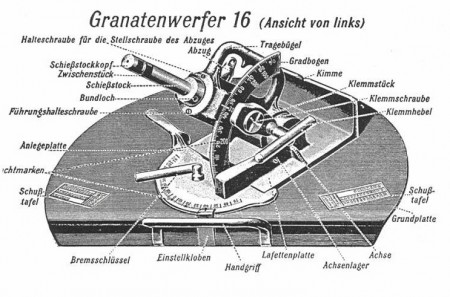
Developed in the Austro-Hungarian army, the Granatenwerfer 16 was a German WWI grenade thrower which bridged the gap between hand-thrown grenades and the light minenwerfers. Throwing a small grenade with a 400g (14oz) high explosive charge to a maximum range of about 300 meters (330 yards) , the Gr.W.16 with a practiced crew could maintain a rate of fire of 4-5 rounds per minute.

It was a classic example of the spigot mortar type weapon. Rather than having a hollow barrel into which the projectile fit, it had a simple rod with a firing pin built in. The grenade it fired had a hollow center shaft, which fit onto the firing rod. To fire, a gunner (a 2-man crew, in practice) would first adjust the spigot rod to the correct angle for the desired range, depress the cocking collar until the firing pin was cocked, rotate the safety lever to the “safe” position, insert a fuse into a grenade (they were fairly sensitive impact fuses), slide the grenade onto the launcher, remove the safety pin, and fire the grenade by means of a lanyard pull.