During 1916 it became clear that in case of a breakthrough, the very purpose of the first tank, the Mark I, artillery would have great trouble following the advancing troops. Any successful offensive would therefore be in danger of stalling immediately. To solve this problem, Major John Greg, an engineer working for the main tank producing company Metropolitan, Carriage, Wagon and Finance, proposed to build special mechanised artillery, using parts of the Mark I.
As you can see the vehicle bore little resemblance to the Mark I however it retained the Daimler 105 hp engine and transmission of the Mark I.
This structure also housed the vehicle commander, a mechanic and two gearsmen. The original double tail wheel of the Mark I (intended to aid steering but often omitted in action) was attached to the rear of the vehicle and seems to be retained in photographs.
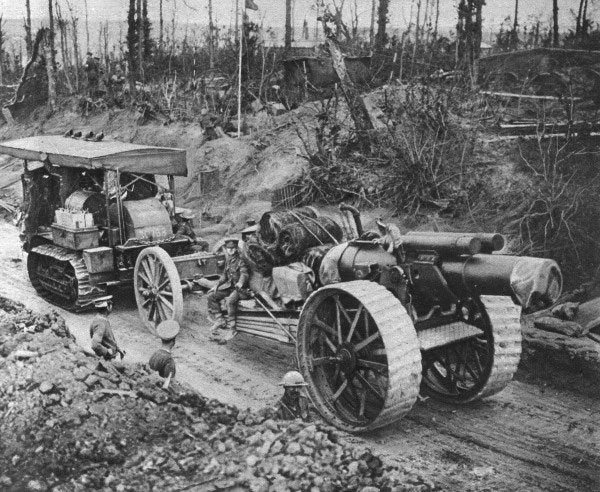
The front section the tall narrow structures at each side, that acted as armoured cabs for driver on the left and brakesman to the right. Between these two structures lay a low-slung pivoting platform able to accommodate a 60-pounder (5-inch) gun, a 6-inch 26 cwt howitzer or any equivalent in stores or personnel.
This platform acted as a loading ramp, down which a loading trolley or cradle could be lowered and positioned beneath the gun carriage. The wheels of the gun were removed and attached to the side of the carrier until needed again. The carriage was lowered onto the trolley which could then be winched up onto the platform using a pair of engine-driven winding drums. Spaces to the rear of the cabs were used to store up to a hundred rounds of ammunition for the howitzer in addition to other warlike stores.
The production of a prototype was approved on 5 June 1916; the actual design began in July. The first prototype was ready to participate in the Tank Trials Day at Oldbury on 3 March 1917. An order of fifty vehicles was given to Kitson & Co. in Leeds. Deliveries to the army started in June and ended in July of the same year.
Two vehicles out of the order of fifty were finished as Gun Carrier Cranes, salvage tanks with a hand-operated crane in the front but without the distinctive pair of forward cabs.
In July 1917, two Gun Carrier Companies were formed of 24 vehicles each. Probably none of them ever fired a shot. As breakthroughs never materialised the vehicles were ultimately only used as supply tanks.